
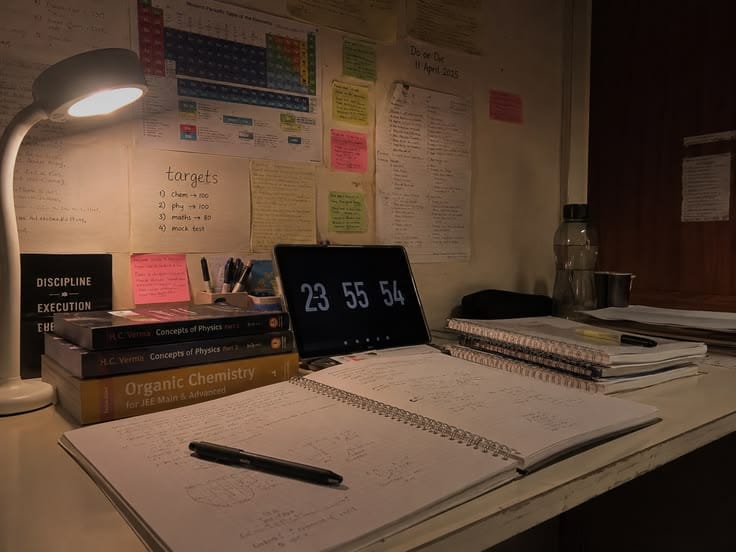
3 a.m., the hour of overthinking
It's 3 am, you've been staring at the same paragraph for twenty minutes, and somehow you've gone from revising chemistry to questioning your subject choices, your future career, and every decision you've made since Year 9.
Naturally, the next logical step is to create an entirely new study timetable.
There's something about studying late at night that makes even the smallest problems feel ten times more serious. One difficult maths question and suddenly you're convinced you're falling behind everyone else. Before you know it, you've opened Notion, planned out the next six months of your life, and decided that tomorrow you'll become one of those people who wake up at 5 AM, exercise, journal, and finish half the syllabus before breakfast.
The funny thing is, making a study plan often feels more productive than actually studying. You can spend an hour colour-coding your schedule, assigning time slots to every subject, and convincing yourself that you've finally got everything under control. Meanwhile, the assignment you opened your laptop to complete remains completely untouched.
Then there's the comparison. Someone in your class has apparently finished revising the entire syllabus, someone on YouTube claims to study twelve hours a day, and there's probably a teenager on LinkedIn who's founded three startups while maintaining perfect grades. It's difficult not to feel behind when everyone seems to be doing more than you, even though you're mostly seeing the parts of their lives they choose to share.
And perhaps that's what makes 2 am such a strange time. You're exhausted, struggling to concentrate, and somehow still convinced that staying awake another two hours will solve everything. With World Mental Health Day on 10 October, it's worth questioning why students so often treat exhaustion as proof of dedication. We've made staying up until ridiculous hours seem almost impressive, as though getting three hours of sleep somehow proves how seriously we take our academics. But there's a difference between working hard and pushing yourself to the point where even a simple paragraph feels impossible to understand.
I've realised that the best way to deal with these late-night spirals isn't to come up with an even more ambitious routine. Sometimes it's just accepting that you've done enough for the day, writing down what needs to be finished tomorrow, and closing the laptop without feeling guilty about it.
There's nothing wrong with wanting good grades or having big ambitions, but one unproductive evening doesn't mean you need to completely reorganise your life.
Realistically, if your brain decides at 2 AM that you need a six-month academic comeback plan, perhaps the first item on that plan should be getting some sleep.